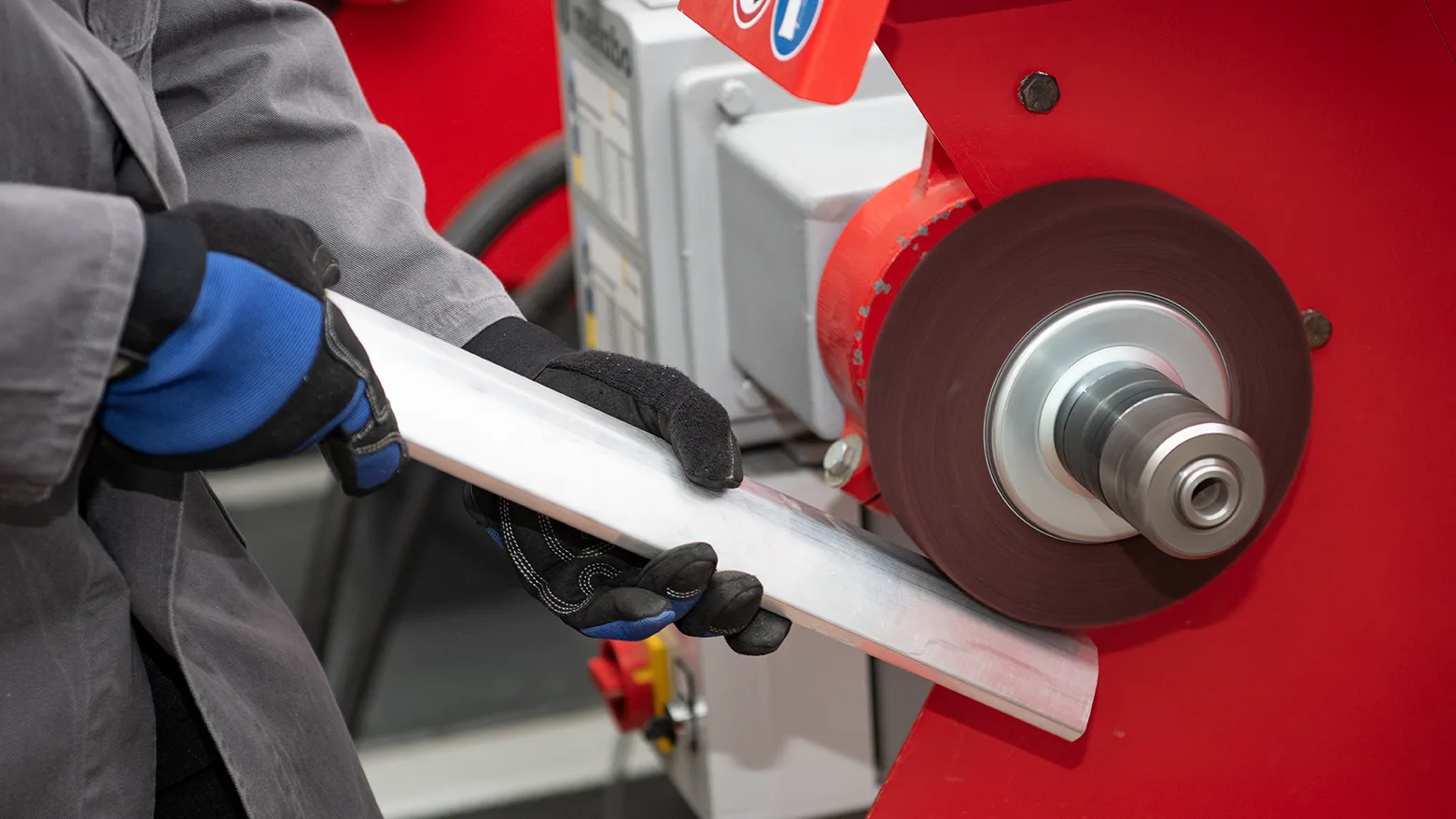
Consistent decorative metal finishes depend on more than grit size. For appliance manufacturers, architectural metal fabricators, and other producers of appearance-critical components, the right non-woven flap brush or interleaf wheel configuration must balance part geometry, cutting requirements, and the desired scratch pattern. Understanding how construction and abrasive selection affect performance helps manufacturers match the tool to the application, and establish a more repeatable finishing process.
Start with the Finish You Need
Before selecting metal finishing abrasives, define the desired result. A directional grain finish requires a different abrasive combination than a satin metal finish. An irregular workpiece may need greater conformity, while a process involving stock removal may require additional cutting action.
Consider these requirements together:
- Appearance: What visual scratch pattern and finish level does the component require?
- Surface roughness: Is there a target arithmetic average surface roughness, or Ra?
- Part geometry: How closely must the abrasive follow contours or irregular surfaces?
- Production needs: How much stock removal is required, and how consistently must the tool perform over longer runs?
These answers help guide abrasive selection beyond grit alone.
Match Brush Construction to the Workplace
A non-woven flap brush consists of strips of buff-and-blend web bonded radially around a central core. Its structure allows the brush to conform to the workpiece while helping maintain the part’s geometry. Three construction considerations influence performance:
- Flap density: Higher flap counts stiffen the brush, promoting a more aggressive cut and higher luster. Lower density improves conformity on irregular surfaces.
- Web loft and orientation: These characteristics influence flexibility, surface contact, and how the brush follows the part.
- Material durability: General Purpose non-woven materials support lighter-duty applications, while High Strength materials support heavier-duty work. Higher-durability abrasives can help reduce wheel wear and wheel-change downtime during longer automated and CNC finishing runs.
Matching these characteristics to the application helps balance cutting action, conformity, and decorative surface appearance.
When to Use an Interleaf Wheel
When an application requires additional stock removal while maintaining a refined finish, an interleaf wheel, also called a combi wheel, offers another option. These tools alternate non- woven webs with flexible coated-abrasive flaps in predetermined ratios, commonly 1:1. The coated abrasive supplies additional cutting action, while the non-woven material supports finish refinement.
Backing flexibility and grain coating also influence performance. X-weight cotton backing provides strength and conformity for complex contours, while a close-coat abrasive application helps distribute contact force across numerous grain points to promote uniform scratch depth and reduce deep, stray scratches.
Together, these features make interleaf wheels useful for processes that require both material removal and a controlled decorative appearance.
Select Abrasive Mineral, Grit, and Operating Conditions
Abrasive mineral and grit selection should reflect the required cutting behavior and final appearance. Aluminum oxide abrasives offer toughness and self-sharpening characteristics suited to general stainless-steel and non-ferrous finishing. Zirconia alumina abrasives provide microfracturing characteristics suited to higher-pressure stock removal and can produce distinct scratch characteristics on harder alloys.
The coated-abrasive and non-woven combination also matters:
- A 120-grit coated-abrasive flap paired with a medium non-woven web produces a distinct directional grain.
- A 180-grit coated-abrasive flap paired with the non-woven material produces a satin finish.
Once the construction is selected, appropriate peripheral speed and pressure help support consistent scratch patterns. Peripheral speed affects how the nylon fibers flex; maintaining the appropriate speed also helps prevent thermal smearing of the web resin onto the metal surface. Pressure influences finishing action and appearance, making both settings essential to the overall process.
Talk to KLINGSPOR About Your Application
Need help matching a non-woven flap brush or interleaf wheel to your finishing requirements? KLINGSPOR’s in-house metalworking specialists work directly with customers to evaluate product performance and application needs. Contact KLINGSPOR to discuss your workpiece, target finish, and production goals.